
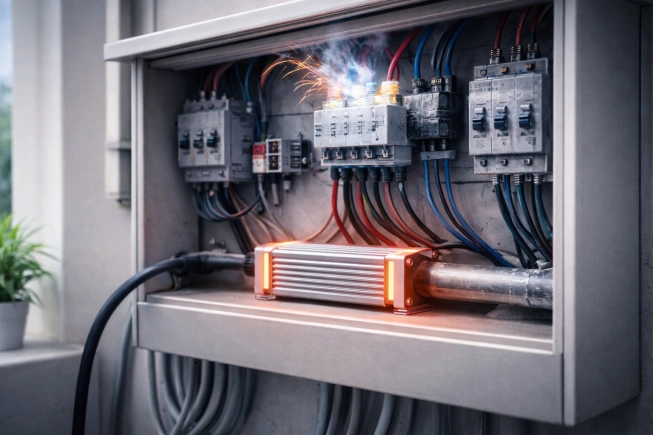
Most heaters need something else to tell them when to stop. A PTC ceramic heater doesn't — it's built to find its own equilibrium, and that single property changes how you design around it.
What "PTC" actually describes
PTC stands for Positive Temperature Coefficient — meaning electrical resistance rises as temperature rises. That's the opposite of a standard resistive heating wire, whose resistance barely changes with temperature, and the opposite of an NTC thermistor, whose resistance falls as it heats up.
A PTC ceramic heating element is made from a doped barium titanate ceramic — a polycrystalline semiconductor engineered to behave like a normal (low-resistance) conductor at room temperature, and then switch behavior sharply once it crosses a specific threshold.
The Curie point is the whole mechanism
That threshold is called the Curie point — the temperature at which the ceramic's crystal structure shifts and its resistivity jumps by several orders of magnitude over a narrow temperature band. Below the Curie point, the material conducts freely and draws significant current, generating heat quickly. Once the element's temperature approaches the Curie point, resistance climbs steeply, current falls, and heat output drops in step.
The result is a heater that throttles its own power draw as it warms, without a thermostat, relay, or microcontroller in the loop. Left connected to power indefinitely, it settles at a stable plateau temperature close to its Curie point and stays there — it doesn't keep climbing the way a fixed-resistance heater would if its control circuit failed.
Why this matters more than it sounds like it should
- Inherent overheat protection. There's no separate thermal cutoff to spec, wire, or fail. The physics of the ceramic is the safety mechanism.
- Even surface temperature. Because each region of the ceramic self-limits independently, a PTC element resists local hot spots that plague wire-wound heaters when insulation or contact varies across the surface.
- Simpler system design. Fewer components between "power in" and "correct temperature out" means fewer failure points and less BOM cost on the control side.
- Fast, predictable warm-up. Full current flows while the element is cold, so it heats quickly on startup, then eases off — useful for cold-start and defrost applications where time-to-temperature matters.
The target temperature is a material decision, not an afterthought
The Curie point isn't fixed — it's set by the ceramic formulation and doping during manufacturing. This is the actual engineering work behind a PTC heater: choosing a composition that plateaus at the temperature your application needs, whether that's 40°C for a seat heater or 220°C for an industrial process heater, while holding tight batch-to-batch consistency so unit #1 and unit #50,000 behave the same way.
Where it shows up in real products
Self-regulating PTC elements are the reason a lot of "smart-seeming" thermal behavior in consumer and industrial products doesn't actually involve any electronics: EV battery preheating that won't overheat cells even if a control signal is delayed, cabin glass defrosters that hold a stable anti-fog temperature, and industrial fluid heaters that can't run away even under a stuck-on fault.
Understanding the resistance-temperature curve is the starting point for choosing the right heater architecture — liquid, air, cased, or chip — which is what we cover in Choosing the Right PTC Heater Type for Your OEM Project.
Have a target temperature in mind?
Send your operating voltage, target temperature and mounting constraints — we'll propose a starting PTC formulation and turn around samples.
Get Free Samples