
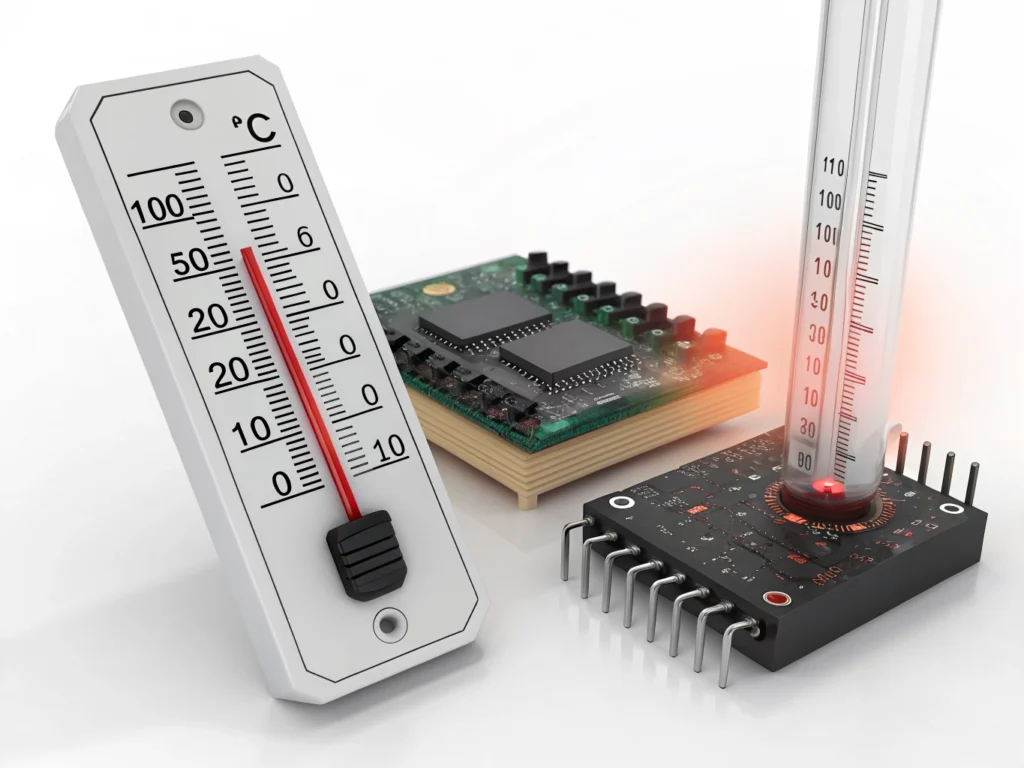
“Positive temperature coefficient” sounds like a spec-sheet footnote. It’s actually the one-line explanation for why some heating elements can’t overheat, some fuses reset themselves, and some sensors would make terrible heaters.
The short answer
A positive temperature coefficient (PTC) describes any material whose electrical resistance increases as its temperature increases. Current in, resistance climbs, current drops back — the material pushes back against its own heating. That’s the opposite of what happens in most everyday conductors and in NTC (negative temperature coefficient) materials, where resistance falls as things warm up.
On its own, “positive temperature coefficient” is just a description of a resistance-temperature relationship. In practice, when people say “PTC” in electronics, they usually mean something more specific: a family of ceramic and polymer materials engineered to show a dramatic, switch-like positive coefficient at a particular temperature — not just a gentle upward slope.
Ordinary PTC behavior vs. engineered PTC materials
Most metals have a mild positive temperature coefficient — copper wire resistance creeps up slightly as it heats, which is why long cable runs derate at high current. That’s real PTC behavior, but it’s too weak and too linear to build a self-regulating heater out of.
Engineered PTC ceramics — typically doped barium titanate — behave completely differently. Below a threshold called the Curie point, they conduct almost like a normal semiconductor. Cross that threshold and resistance jumps by several orders of magnitude over a narrow temperature band. That step-function jump, not just “resistance goes up a bit,” is what makes PTC ceramics useful as heating elements and resettable fuses rather than just a curiosity of materials science.
Curious how this becomes a working heater?
See how the Curie-point jump translates into a stable, self-limiting operating temperature.
Why the “positive” part is the whole point
A negative temperature coefficient material does the opposite: resistance falls as it heats. That makes NTC devices excellent temperature sensors — smooth, continuous resistance change maps cleanly back to a temperature reading — but useless as a self-limiting heater, since there’s no natural point where an NTC element throttles its own current. We cover this contrast in more detail in PTC vs. NTC thermistors: key differences explained.
PTC’s rising resistance is what makes it self-protecting instead of self-destructive. As a PTC element approaches its Curie point, rising resistance chokes off current before the material can run away into thermal failure — the same property that makes PTC heaters inherently overheat-resistant also makes PTC devices useful as resettable fuses that trip on overcurrent and reset once things cool down.
Positive Temperature Coefficient
Resistance rises with temperature. Used for self-regulating heating and overcurrent protection. Engineered PTC ceramics show a sharp jump at the Curie point.
Negative Temperature Coefficient
Resistance falls with temperature. Used mainly for temperature sensing, where a smooth, continuous curve gives an accurate reading.
Where PTC materials actually show up
| Form | What it does |
|---|---|
| PTC ceramic heater | Self-limiting heating element — see what is a PTC heater for the full picture |
| PTC resettable fuse | Trips on overcurrent, resets automatically once current drops and it cools |
| PTC starter/protector | Used in motor start circuits and compressors to limit inrush current |
PTC heating elements alone come in several physical formats depending on what’s being heated and how the part needs to mount — liquid, air, cased, insulated and chip forms. If you’re trying to match a format to an actual project, choosing the right PTC heater type for your OEM project walks through that decision, and the full product catalog covers every sub-type we manufacture — including liquid, air, cased, insulated and chip formats.
For a sense of where this shows up in real products — EV battery preheating, anti-freeze pipe wraps, medical storage, pet beds and more — our use cases page keeps a running list of applications built around exactly this property.
Who makes them
PTCWORKS has manufactured PTC ceramic components since 1993, formulating the ceramic itself to hit a target Curie point rather than just assembling from off-the-shelf material. If you’re specifying a PTC device for the first time, our team can help you work out whether you need the heating side of PTC or the protection side — or keep reading on the PTCWORKS blog for more fundamentals like this one.
Have a specific application in mind?
Tell us whether you need self-limiting heat or overcurrent protection, plus your target temperature and voltage — we’ll point you to the right starting product.