
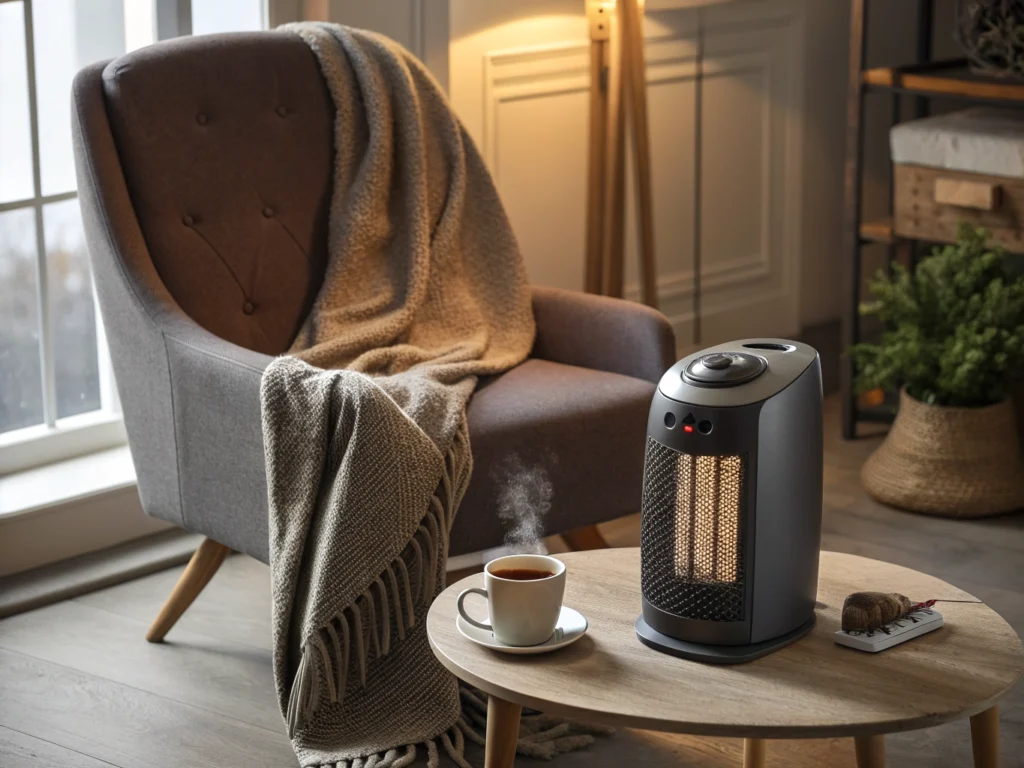
Point a fan at a red-hot wire coil and you get warm air fast, but not much control. Point it at a self-limiting PTC ceramic element instead, and you get warm air just as fast — without the fire risk sitting behind the grille.
The short answer
A PTC fan heater pairs a self-regulating PTC ceramic heating element with a fan that pushes air across it, delivering fast, directional warm airflow. In PTCWORKS’ product line this is the forced-air type of Air Heater — one of two airflow architectures we manufacture, the other being convection (no fan, passive airflow).
How it works
The heating core is the same doped PTC ceramic used across our product range: resistance stays low while the element is cold, so it draws current and heats up quickly, then climbs sharply once it nears its target temperature — throttling its own output instead of continuing to climb. A fan mounted behind or beside the element pulls that heat off the ceramic surface continuously and pushes it out as warm air, which also keeps the element itself from sitting at a static hot-spot temperature the way a sealed, unventilated heater might.
Building a product around forced-air heat?
Send your target airflow, wattage and enclosure size — we’ll propose a starting element and fan pairing.
Why manufacturers choose PTC over a bare resistance coil
- No exposed red-hot element. A PTC ceramic core self-limits well below the temperatures a nichrome coil can reach, which matters for anything a hand, pet or curtain might get near.
- Fast warm-up. Full current flows while the ceramic is cold, so PTC fan heaters reach working temperature quickly — a big part of why they’ve replaced coil elements in hair dryers and portable space heaters.
- Consistent output over the unit’s life. The Curie-point ceramic doesn’t degrade the way a resistance wire thins and drifts with age and oxidation.
- Built-in fault tolerance. If the fan fails and airflow drops, a PTC element’s self-limiting behavior caps how hot it can get — a bare coil has no such ceiling.
For the physics behind that self-limiting behavior, see how PTC ceramic heaters self-regulate temperature.
Forced-air vs. convection: which one is a “fan heater”?
Forced-Air (fan heater)
Fan-driven, directional, fast heat delivery. Best for space heaters, hair dryers, hand dryers, defrost systems and anywhere you need heat aimed somewhere specific, quickly.
Convection (no fan)
Passive airflow, quieter, no moving parts. Best for enclosure heating, cabinets, and anywhere fan noise or power draw isn’t acceptable.
Both are covered under our Air Heater product line. If you’re not sure which fits your project, choosing the right PTC heater type for your OEM project walks through the decision framework across all five product families, and the full catalog covers every sub-type we manufacture.
Where PTC fan heaters show up
Beyond the obvious space heaters and hair dryers, forced-air PTC elements turn up in vehicle cabin HVAC, hand dryers, industrial drying tunnels, and defrost systems. Our use cases page tracks real applications like these if you want to see whether your project matches an existing pattern.
Who makes them
PTCWORKS has manufactured PTC ceramic heating elements since 1993, including the forced-air and convection cores used in fan heater assemblies. If you’re pairing a PTC element with your own fan and housing design, our team can help size the element to your target airflow and wattage — or keep reading on the PTCWORKS blog for more guides like this one.
Ready to spec your fan heater?
Tell us your target airflow, wattage and enclosure size — we’ll recommend a starting element and turn around samples.