
Chemical Reagent Anti-Freezing
Freezing damages more than convenience — for many reagents, a freeze-thaw cycle degrades the chemistry itself. Keeping storage tanks above their freeze point reliably, without overshooting into a heat-sensitive range, is the whole engineering problem.
Reagent storage has a narrow acceptable band: cold enough to freeze on one side, heat-sensitive degradation on the other. A heater that can only turn fully on or fully off doesn’t fit that band well.
Why this is a freeze-protection problem, not a general heating problem
Many chemical reagents degrade or separate if they freeze, but some are also sensitive to excess heat — so the ideal heating source holds a narrow band just above freezing rather than delivering maximum output indefinitely. A self-regulating PTC element does this by physics: it draws heavy current while cold, then throttles output automatically as it nears its target temperature, holding a stable plateau rather than continuing to climb.
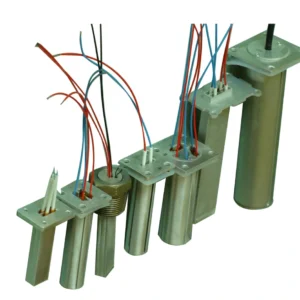
Immersion type
Submerges directly in the storage tank, holding the reagent just above its freeze point without a separate external controller.
View Liquid Heater products →Why PTC fits reagent storage specifically
- No thermal runaway risk near heat-sensitive chemistry — see is a PTC heater safe.
- Stable target temperature set during ceramic formulation, not dependent on an external control loop that could fail.
- Simple integration into existing storage tanks via immersion or bottom-mounted architectures.
See anti-freeze for outdoor water pipes for a related freeze-protection case, or browse Liquid Heater for the full range of mounting options. PTCWORKS can formulate an element to your reagent’s specific freeze point — contact our team with your tank size and target temperature.
Protecting temperature-sensitive storage?
Send your tank volume, target temperature range and voltage — we’ll recommend a starting element.